By the Perth Concrete Driveways team
Published 8 July 2026
AI Overview
Rebar reinforces a concrete driveway from the inside, helping it resist cracking, ground movement and heavy vehicle loads. Whether your driveway needs rebar depends on the load, slab thickness and soil conditions, so it is not always required. Correct placement on bar chairs, in the middle of the slab, is what makes reinforcement actually work.
Key highlights
- Rebar for concrete driveway projects improves structural strength by helping concrete resist tensile forces.
- It can reduce the risk of significant structural cracking caused by vehicle loads and ground movement.
- Not every driveway requires rebar, and the most suitable reinforcement depends on the site and intended use.
- Proper installation is just as important as selecting the right reinforcement.
- Reinforcement should always be considered alongside slab thickness, drainage and site preparation.
Summarise with AI
Concrete is one of the most durable materials for a residential driveway, but adding rebar for concrete driveway construction can improve its structural strength in the right circumstances. Steel reinforcing bars help concrete resist the forces created by vehicle loads, ground movement and temperature changes, making the slab more resilient over time. While not every driveway requires rebar, choosing the right reinforcement can help improve long-term performance.
At Perth Concrete Driveways, we’ve built driveways across Perth in a wide range of ground conditions. We understand that every property is different, so reinforcement should always be selected based on the site’s conditions and how the driveway will be used. In this guide, we’ll explain how rebar works, when it’s recommended.
Key Takeaways
- Rebar for concrete driveway projects improves structural strength by helping concrete resist tensile forces.
- It can reduce the risk of significant structural cracking caused by vehicle loads and ground movement.
- Not every driveway requires rebar, and the most suitable reinforcement depends on the site and intended use.
- Proper installation is just as important as selecting the right reinforcement.
- Reinforcement should always be considered alongside slab thickness, drainage and site preparation.
What Is Rebar?
Before deciding whether rebar for concrete driveway construction is suitable for your project, it’s helpful to understand what rebar actually does. Although it’s hidden inside the concrete once the driveway is poured, it plays an important structural role throughout the life of the slab.
Rebar, short for reinforcing bar, is a steel bar placed inside concrete before it hardens. Once the concrete cures, the steel and concrete work together as a single structural system.
Concrete has excellent compressive strength, meaning it performs well when supporting weight pushing down on it. However, concrete is much weaker when subjected to tensile forces created by bending or movement. This is where reinforcement becomes valuable.
Steel has very high tensile strength. By embedding steel reinforcing bars inside the slab, concrete becomes better equipped to resist the forces created by everyday vehicle traffic and natural ground movement.
Rather than preventing every crack, rebar for concrete driveway construction helps the slab remain structurally stronger under load. If minor cracking occurs over time, the reinforcement also helps hold the concrete together and limits movement within the slab.
This combination of concrete and steel has been used for decades because each material compensates for the other’s weaknesses.
Why Do Concrete Driveways Need Reinforcement?
Concrete driveways experience far more than the weight of a parked car. Every day, they are subjected to loads, movement and environmental conditions that place stress on the slab. Reinforcement helps the driveway cope with these conditions and improves its ability to perform over many years.
The amount of reinforcement required depends on several factors, including the driveway’s size, the expected vehicle loads and the site’s ground conditions.
Vehicle Loads
Every vehicle transfers weight through the driveway and into the ground below.
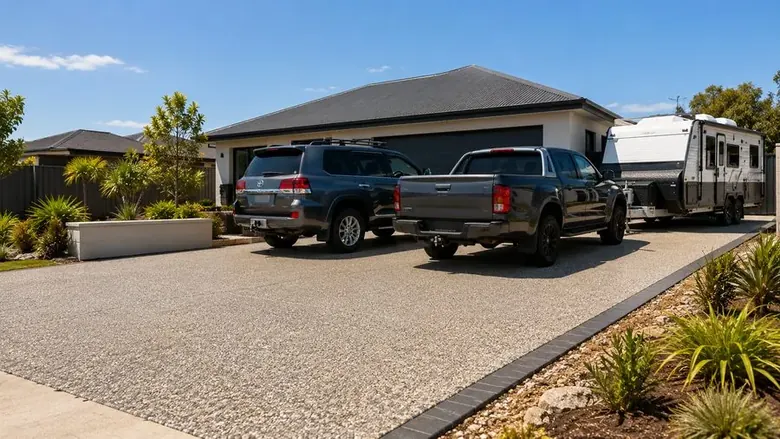
Modern SUVs, dual-cab utes, caravans and trailers place significantly more stress on concrete than smaller passenger vehicles. Over time, repeated loading creates tensile forces within the slab that concrete alone is less capable of resisting.
Does a concrete driveway need rebar? The answer depends on how the driveway will be used. A standard suburban driveway used by family cars may have different reinforcement requirements from a driveway that regularly supports heavier vehicles.
Ground Movement
Ground movement is another factor that influences driveway performance. Across Perth, soil conditions vary considerably. Some areas have stable limestone-based ground, while others contain reactive clay that expands and contracts as moisture levels change.
Even with proper site preparation, small amounts of natural movement can still occur over time. When the ground shifts, bending forces develop within the concrete slab. Reinforcement helps the driveway resist these forces and maintain its structural integrity.
A properly designed rebar concrete driveway may provide additional support where ground movement is expected or heavier loading is anticipated.
Australia’s Climate
Concrete also responds to changes in temperature.
During Perth’s hot summers, concrete expands slightly. As temperatures cool, it contracts again. These movements are small but completely normal throughout the life of the driveway. Control joints are installed to help manage this movement, while reinforcement provides additional structural support as these stresses develop.
Good driveway performance comes from combining several construction practices rather than relying on one solution alone.
Reinforcement Is Only One Part of a Durable Driveway
It’s easy to assume that adding more steel automatically creates a stronger driveway, but reinforcement is only one part of the overall construction process.
Long-lasting driveways rely on a combination of quality workmanship, including:
- Proper site preparation.
- A well-compacted base.
- Appropriate slab thickness.
- Effective drainage.
- Correct reinforcement placement.
- Proper curing after the concrete is poured.
When all these elements work together, the driveway is better equipped to handle everyday use and changing ground conditions.
How Rebar Compares With Concrete Alone
The table below highlights the difference between an unreinforced slab and one that uses rebar for concrete driveway construction where appropriate. It demonstrates how steel reinforcement improves a driveway’s ability to withstand heavier loads and everyday structural stresses.
| Feature | Concrete Without Rebar | Concrete With Rebar |
|---|---|---|
| Tensile strength | Lower | Higher |
| Resistance to heavy vehicle loads | More limited | Improved |
| Structural stability | Relies on concrete alone | Steel and concrete work together |
| Ability to manage ground movement | Lower | Improved |
| Long-term durability | Depends heavily on site conditions | Better suited to higher structural demands |
Understanding these differences helps explain why reinforcement is recommended for some driveways but not all. The right choice always depends on the property’s ground conditions, expected vehicle loads, slab design and how the driveway will be used over the long term.
The Benefits of Using Rebar for Concrete Driveway Reinforcement
Choosing the right reinforcement can make a significant difference to how well a driveway performs over its lifetime. While using rebar for concrete driveway construction is not necessary for every project, it offers important structural advantages where additional support is required.
The benefits extend beyond simply making the slab stronger. Properly specified and installed reinforcement helps concrete cope with vehicle loads, ground movement and everyday wear, giving homeowners greater confidence in the long-term performance of their driveway.

Improves Structural Strength
The primary purpose of using rebar for concrete driveway construction is to improve the slab’s ability to resist tensile forces created by vehicle loads and bending. Instead of allowing stress to concentrate in one area, the steel reinforcement helps distribute these forces more evenly throughout the concrete.
This added strength can be particularly beneficial for driveways used by heavier vehicles such as SUVs, dual-cab utes, caravans, trailers and light commercial vehicles. These vehicles place greater demands on the concrete than a standard passenger car.
Helps Control Structural Cracking
A common misconception is that reinforcement completely prevents concrete from cracking. In reality, concrete naturally develops minor shrinkage cracks as it cures, and small surface cracks may also appear over time.
The role of reinforcement is to help reduce the likelihood of larger structural cracks developing. If cracking does occur, the reinforcing bars help hold the slab together and reduce movement, improving the driveway’s overall structural integrity.
Rebar also works alongside properly placed control joints, suitable concrete thickness and good construction practices to help manage natural movement within the slab.
Improves Long-Term Durability
A driveway is expected to provide reliable performance for many years, so durability is an important consideration during construction. Reinforcement helps the slab better withstand repeated vehicle traffic, changing weather conditions and minor ground movement throughout its life.
A well-designed rebar concrete driveway is generally more capable of maintaining its structural stability under demanding conditions, which may reduce the likelihood of significant structural repairs later.
Provides Additional Support in High-Load Areas
Some sections of a driveway experience greater stress than others. Parking areas, driveway entrances, crossover sections and locations where trailers or caravans are stored often carry higher loads over long periods.
Where appropriate, using rebar for concrete driveway construction can provide additional reinforcement in these areas, helping the slab better withstand repeated loading and everyday use.
How Rebar Works Inside Concrete
Although rebar is hidden once the concrete has cured, it continues to perform an important structural role throughout the driveway’s life. The reinforcement works together with the surrounding concrete to help the slab resist forces that would otherwise place it under greater stress.
Whenever a vehicle drives onto the driveway, small amounts of bending occur within the slab. While this movement is usually too small to notice, it creates tensile forces inside the concrete.
Concrete alone has limited tensile strength, so repeated loading over many years can increase the likelihood of structural cracking if the slab is not appropriately reinforced.
Steel reinforcing bars absorb much of this tensile stress. Instead of concentrating loads in one location, the reinforcement helps distribute forces throughout the slab, allowing the concrete and steel to function as a single structural system.
The result is a driveway that is better equipped to cope with everyday traffic, natural ground movement and changing weather conditions.
Why Proper Rebar Placement Matters
Using the correct reinforcement is only part of building a durable driveway. The reinforcement also needs to be installed correctly to deliver the structural benefits it was designed to provide.
Poor placement can significantly reduce the effectiveness of rebar usage, even if the correct reinforcing bars have been selected.
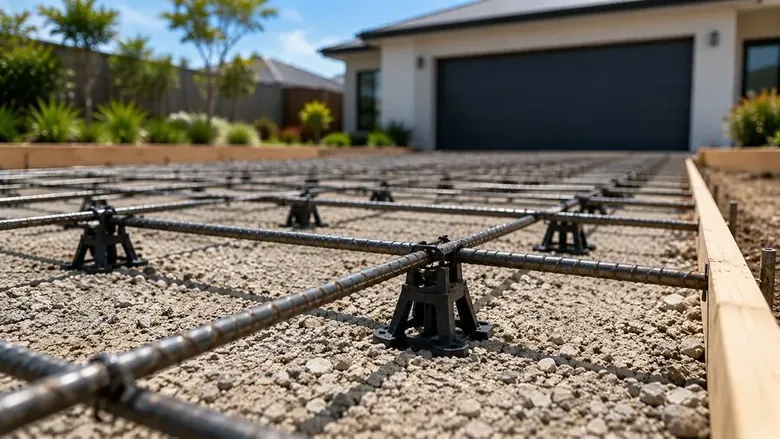
One of the most common installation mistakes is allowing reinforcing bars to sit directly on the ground before the concrete is poured. When this happens, the steel ends up too low within the slab and cannot effectively resist tensile forces where reinforcement is needed most.
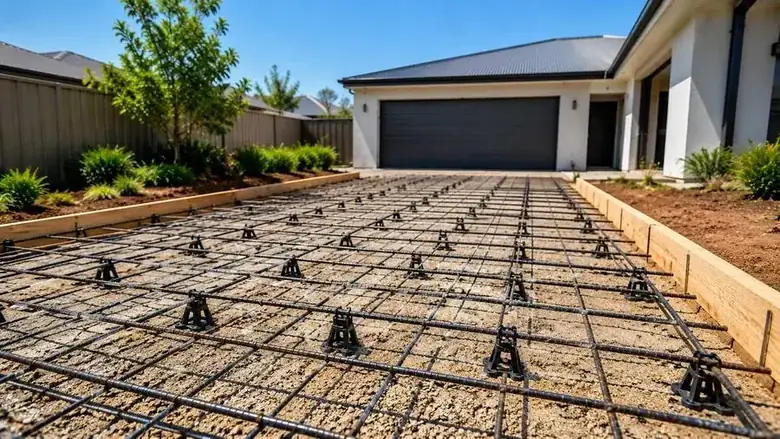
Professional concreters use bar chairs to support the reinforcement at the correct height, maintaining the required concrete cover around the steel during the pour.
The spacing, layout and bar size also need to suit the driveway’s design and expected vehicle loads. Simply adding more steel does not necessarily create a stronger driveway if it has not been positioned correctly.
| Correct Installation Practice | Why It Matters |
|---|---|
| Use bar chairs | Keeps the reinforcement at the correct height within the slab. |
| Maintain adequate concrete cover | Protects the steel while allowing it to perform effectively. |
| Correct spacing and layout | Helps distribute loads evenly throughout the driveway. |
| Match reinforcement to the driveway design | Ensures the slab is reinforced according to expected vehicle loads and site conditions. |
Correct reinforcement placement, combined with proper site preparation, concrete thickness and curing, helps produce a driveway that is built for long-term performance.
Types of Rebar Used in Australian Concrete Driveways
Not all reinforcing bars are the same. The best choice depends on the driveway’s structural requirements, site conditions and any engineering specifications. For most residential driveways in Australia, deformed rebar is the standard option because it provides excellent bonding with concrete.
| Type of Rebar | How It Works | Typical Use |
|---|---|---|
| Deformed Rebar | Raised ribs create a strong bond with the surrounding concrete, helping prevent the steel from moving under heavy loads. | The standard choice for most Australian residential concrete driveways. |
| Galvanised Rebar | Zinc coating provides additional protection against corrosion and rust. | Suitable for driveways exposed to higher moisture levels or more corrosive environments. |
| Epoxy-Coated Rebar | Protective epoxy coating helps reduce corrosion by creating a barrier between the steel and moisture. | Used where extra corrosion resistance is specified or considered beneficial. |
Most Perth residential driveways use standard deformed rebar because it provides the strength and durability needed for everyday vehicle traffic. Corrosion-resistant products are generally reserved for projects where site conditions or engineering requirements call for additional protection.
When Is Rebar Recommended for a Concrete Driveway?
The answer depends on the driveway’s design, the expected vehicle loads and the site’s ground conditions. There is no single reinforcement method that suits every project. Choosing the right solution means considering how the driveway will be used over the long term rather than applying the same approach to every property.
Driveways Used by Heavier Vehicles
Modern vehicles are becoming larger and heavier. Many households now own SUVs, dual-cab utes, caravans, camper trailers or boats that place greater loads on a driveway than a standard passenger car.
Where these higher loads are expected throughout the driveway’s life, rebar for concrete driveway construction may provide additional structural support.
Reactive Soil Conditions
Some parts of Perth are built on reactive clay soils that expand and contract as moisture levels change. Even with proper site preparation, minor ground movement can still occur over time.
Where these conditions exist, reinforcement may help the slab better withstand the stresses created by natural ground movement.
Long or High-Use Driveways
Larger driveways and those that experience constant vehicle traffic are subjected to greater structural demands than shorter residential driveways. Reinforcement can help improve long-term stability when the driveway is expected to support frequent use or heavier loading over many years.
Engineered Projects
Some driveway projects require engineering specifications because of unusual site conditions, retaining walls, steep gradients or other structural requirements. In these situations, the reinforcing bars, spacing and layout are determined by the engineering design to meet the project’s structural requirements.
Does Every Concrete Driveway Need Rebar?
The simple answer is no. Not every residential driveway requires steel reinforcing bars, and using more reinforcement does not automatically create a better driveway.
Does a concrete driveway need rebar? This is one of the common questions we hear from homeowners, especially when discussing the cost of a new driveway. The answer depends on the expected vehicle loads, slab thickness, ground conditions and the overall driveway design.
Many residential driveways perform very well using reinforcing mesh where the site’s conditions make it suitable. Others benefit from reinforcing bars because additional structural strength is needed.
The goal is not to use the greatest amount of steel. It is to select the reinforcement that best matches the driveway’s intended use.
Is rebar necessary for a concrete driveway? The answer varies from one project to another. Every driveway should be assessed individually before deciding on the most appropriate reinforcement.

What Size of Rebar Should Be Used?
There is no single reinforcing bar size that suits every residential project. The appropriate bar diameter and spacing depend on several factors, including slab thickness, expected vehicle loads, soil conditions and any engineering requirements.
For most residential driveways, reinforcing bars are selected to suit the structural design rather than simply choosing the largest available steel. Using bars that are larger than necessary rarely provides additional value if the driveway has already been designed appropriately.
Reinforcement should always be considered alongside proper excavation, base preparation, concrete thickness, drainage and accurate placement within the slab. Together, these factors determine how well the finished driveway performs over time.
Frequently Asked Questions
Not always. Whether does a concrete driveway need rebar depends on factors such as vehicle loads, slab thickness, soil conditions and the driveway's design. Some residential driveways are adequately reinforced with steel mesh, while others benefit from reinforcing bars.
The appropriate bar size depends on the structural design, expected loads and site conditions. Reinforcement should always be selected to suit the individual project.
Yes. A properly designed rebar concrete driveway provides greater resistance to tensile forces than plain concrete. The steel reinforcement works with the concrete to improve structural performance under load.
No. Reinforcement doesn't eliminate all cracking. Small shrinkage cracks can still occur as concrete cures. The purpose of rebar for concrete driveway construction is to reduce the likelihood of significant structural cracking and help keep the slab stable if minor cracks develop.
Building a Driveway That Lasts
Using rebar for concrete driveway construction can improve structural strength, durability and long-term performance when it is appropriate for the project. The right reinforcement depends on factors such as expected vehicle loads, ground conditions and the overall driveway design, making it important to assess each property individually.
A durable driveway is the result of more than reinforcement alone. Proper site preparation, drainage, slab thickness, concrete placement and workmanship all contribute to a finished surface that performs well in Perth conditions for many years.
If you’re planning a new concrete driveway and would like practical advice on the right reinforcement for your property, Perth Concrete Driveways can help. We provide honest recommendations, fixed-price quotes and quality concrete driveways built to suit your home’s needs.
Covered in this guide
Perth Concrete Driveways
Perth's concrete driveway specialists. Free quotes across the metro area. Last updated 8 July 2026.